For ranking methodology and other information about the series, see the original post. To read the about the No. 9-rated stadium, the Bombonera in Buenos Aires click here. To see all "soccer mecca" entries click here.  8. Estadio Monumental Antonio Vespucio Liberti (El Monumental), Buenos AiresOpen since:
 1938 (renovated 1978)
Capacity: 66,000
Tenant(s): River Plate, Argentine national team
World Cup hosts: 1978
Closest U.S. stadium comparison: Yankee Stadium, Bronx, N.Y.
If the Bombonera is Argentina's version of Fenway Park--an odd-shaped, quirky, loud grounds in a residential neighborhood--then El Monumental is Yankee Stadium: big, grandiose, corporate, of "the establishment." Some of that of course stems from the identity of the stadium's main tenent; River Plate is very much the "establishment" club of Argentina (one of the club's nicknames is
los millionarios, or the millionaires), and of the posh Nunez neighborhood where El Monumental was built. Just like the Yankees...if Yankee Stadium weren't in the Bronx, that is.
The Monumental is the national grounds of Argentina, where its storied
albicelestes play (nearly all) their home games. Imagine if Wembley Stadium also hosted, say, Chelsea, or the Stade de France held Paris Saint Germain games, and you get a a bit of the idea.
Wait, so if the Bombonera was already featured, what is the Monumental doing here? Are there really two stadiums from one city in the list of top 10 soccer meccas? Yes there are. However, both are relatively far back in the rankings (at eight and nine there are seven stadia still ahead of them). Each is distinct and famous in its own right (and for different reasons at that). It would have been an injustice to leave out one or the other. So there you have it.
El Monumental was Argentina's first industrial, steel and concrete soccer stadium and consists of two tiers in the shape of a horse shoe. During its early years it contained a school and medical practice.
The Monumental edges the Bombonera in the standings for one simple reason: it hosted a World Cup. Not only that, but it was the scene of both the 1978 final and third-placed games (won by Argentina and Brazil, respectively).
That World Cup tournament is historically significant, but sadly for all the wrong reasons. It was a propaganda coup for the military junta that ruled Argentina at the time (indeed 1978 may have very well been the peak of its power--no coincidence there). In this respect, many have compared it to the 1936 Olympics in Berlin. An
LA Times article from last year deals with this theme at greater length.
In the three decades since the tournament, other nefarious allegations have surfaced. Did the Colombian mafia bribe the Peruvian national team to throw its second round game with the host nation, as
this Daily Mail piece points out? Were the Argentine players doped for the final? (A urine sample that was supposed to have been taken from an Argentine player showed the individual in question to be pregnant, a strong indication that the samples were at least tampered with, if not doctored outright).
As for the Monumental, it hosted Argentina's first round games but not the infamous win over Peru (or the violent scoreless draw against Brazil; those matches were held in Rosario). It did host a preview of the 1982 final, between Italy and West Germany (the game ended scoreless) as well as Italy's first round upset of the hosts (a 1-nil game where a certain Paolo Rossi assisted on the winning goal) that kept Argentina from playing its second round games at El Monumental. It was also where Argentina narrowly defeated France (with a young Michel Platini) in its opener.
And of course the final, an overtime thriller the hosts won through a brace by their hero Mario Kempes, was held here. That match, undoubtedly the most famous in the stadium's history, and probably one of the most exciting World Cup finals of all time, was not without controversy either. The home side didn't like the Israeli referee assigned to the match so it lobbied (successfully) for an Italian one. Argentine players delayed the kickoff protesting a cast on the arm of a Dutch player. Once it finally started, the home side (through Kempes, natch) took a first half lead before Holland's Dick Nanninga equalized eight minutes from time. The Netherlands apparently had Argentina on the ropes at this point and were robbed of a clear penalty moments after the equalizer by the Italian referee. In stoppage time they came an inch or two from winning their only World Cup when Robbie Rensinbrink fired a shot off the post from point blank range. The
Oranje have not come close since. The Argentines scored twice in overtime to clinch the victory.
Did the most famous Argentine player of all time ever play at El Monumental? Not in that World Cup he didn't. The then-17-year old Diego Armando Maradona was left off of Cesar Luis Menotti's squad. But there were many other appearances, including several for the Argentine national team. He scored several goals as well, both for the albicelestes and for club side Boca Juniors. His first appearance at the Monumental may have been as early as 1973 when his Argentinos Juniors' Cebollitas youth club beat River's juniors 5-4 in a city final, according to the Leandro Zannoni book
Vivir en los medios: Maradona off the record (page 21). It appears
Maradona played his last match as a professional at the Monumental, in a 1997 SuperClasico won by Boca Juniors to whom he had returned in 1995. Maradona also coached his first game for the Argentina national team here, a
4-0 victory over Venezuela this March.
Other than the '78 tournament, the stadium may unfortunately be best known for the
Puerta 12 tragedy of June 23, 1968 (a decade and two days before the Holland-Argentina final). 71 fans were killed in a crush at the Monumental's Gate 12. There are various explanations of what happened in what was one of the worst incidents with soccer fans in the history of the sport (and the worst on Argentine territory, ever).
Of course there are happier memories as well. Many from the annual SuperClasico between Boca Juniors and River Plate. In October, 1972 the home side went up two-nil, was scored on four straight times, rallied to win 5-4 in the highest-scoring SuperClasico of all time. Another famous River comeback was in 1997, when the home side was down three goals but managed to eke out a 3-3 draw. Boca Juniors had their moments as well, the biggest (by score at least, not necessarily magnitude) in a 5-1 blowout victory in March 1982. More recently, in 2004 Boca won the return leg of a Copa Libertadores semifinal on penalties after the two sides traded goals in the final minutes (Carlos Tevez supplied one of the goals for Boca Juniors).
In 1986, River won their first Copa Libertadores final, winning the return leg at the Monumental over America of Colombia by 1-0 (they won the first leg 2-1). This event was repeated, with identical protagonists, in the 1996 version of the final, though this time River lost the first leg at Cali before coming through in the return at the Monumental.
The Argentine national team has played several historic matches here (beyond 1978 of course) and a few they'd rather forget. The biggest of the latter may be a 5-0 loss to Colombia in a 1993 World Cup qualifier, a scoreline made even more incredible by the fact that Argentina had a 33-game unbeaten run coming into the game. (Was this what caused Pele to famously predict Colombia would win the World Cup in 1994? Who knows). The
albiceleste were forced to play a qualifier with Australia as a result.
Another bitter memory (from an Argentine point of view) came in the semifinals of the 1987 Copa America games, where Uruguay upset the hosts 1-0. Uruguay went on to win the tournament over Chile (also at the Monumental). Argentina didn't even win the game for third place, succumbing to Colombia.
More pleasant albiceleste memories are the 1946 South American championship. Argentina played several times at the Monumental, winning all games including the final against Brazil in another famous encounter marked by fighting on the pitch with police. In the 1959 iteration of the tourney, Argentina beat Brazil (with a 19-year old Pele) again in the final--again at the Monumental.
Speaking of Pele, he did quite well at the Monumental. In the aforementioned 1959 tourney, he scored an astonishing eight times in six games. Amazingly, those
appear to have been the only times Pele ever played in Argentina as a member of the
selecao (not sure about his appearances with his club side. Somebody else can research that).
Now is where all the Boca fans can cry about the injustice of putting the Monumental ahead of their beloved Bombonera. Have at it,
Xeneizes!
Photo taken from 100x100millonario.blogspot.com
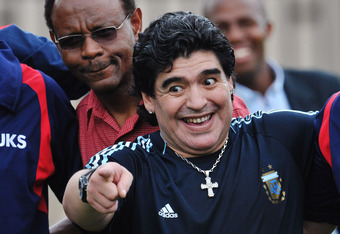 Few people would mistake Diego Armando Maradona for a sane man. That has been clear for some time now--probably since he first entered the public conscience nearly 30 years ago.
